Document Automation
Product features
By practice area
By company size
Contract Review
PRODUCT FEATURES
Resources
LearN
Case Studies
Pricing
Harvey and Gavel Exec are both AI tools for contract review and drafting, and both offer Microsoft Word integrations. Harvey is an enterprise-focused legal AI platform with custom pricing and a demo-led evaluation process. Gavel Exec costs $160 per user per month, offers 25 free queries with no credit card required, and supports contract review in Word and online.
Bottom line: Harvey is powerful but enterprise-heavy. Gavel Exec is easier to try, easier to price, faster to configure, and more focused on contract review in Word and online.
The main difference is scope. Harvey is built as a broad legal AI platform for large firms, professional services organizations, and enterprise legal teams. Gavel Exec is built for transactional attorneys, in-house counsel, and small to midsize legal teams that want contract review, redlining, playbooks, and drafting without enterprise procurement.
Harvey

Harvey is a broad legal AI platform for drafting, research, document analysis, workflow automation, and large-scale document review.
Gavel Exec
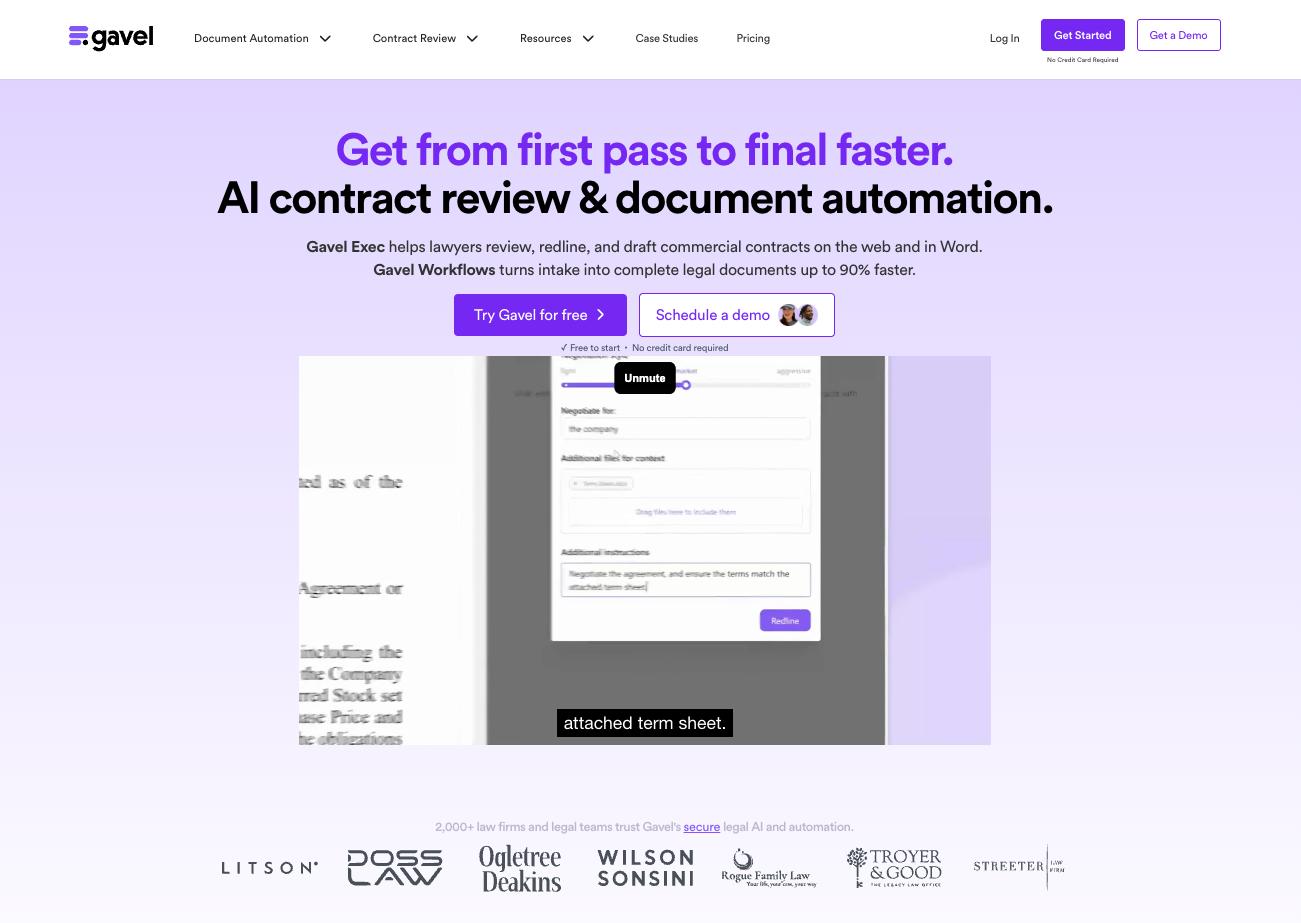
Gavel Exec is AI contract review, redlining, and drafting software for legal teams. It works in Microsoft Word and online, so attorneys can review contracts inside Word or use browser-based workflows for broader contract analysis.
Gavel Exec supports playbook-based review, redlining, drafting, benchmarking, batch analysis, and multi-document comparison. Playbooks can be generated with AI, built from uploaded files, created manually, or started from built-in playbooks created by practicing attorneys. Gavel Exec publishes pricing at $160 per user per month or $1,740 per user annually, and offers 25 free queries per user with no credit card required.
legal teams should know that it is a broad enterprise legal AI platform for legal research, drafting, due diligence, document analysis, and workflow automation, with a Word add-in alongside a primarily web-based interface. Pricing is by quote and depends on seats, products and contract terms, with Harvey's help center putting the average at several hundred dollars per user per month, and access is demo-led with a subscription required for Harvey for Word. There is no self-serve free trial.
Gavel Exec is a narrower purchase than a firm-wide legal AI platform: contract review, redlining, and drafting software for in-house counsel, delivered through a Microsoft Word add-in, with a full web app for batch analysis, multi-document comparison, and research tools. It can be bought without enterprise procurement at $160/seat/month or $1,740/year billed annually, with no long-term commitment, and tried first with 25 free queries per user and no credit card or sales call. Lawyers build playbooks with AI from a contract type or practice area in minutes, begin with lawyer-written defaults, and edit them without admin, with granular read-only or edit access. Gavel never stores contract data, uses it for training, or retains it after a session, a commitment written into formal Zero Data Retention agreements with all AI providers. Customer data sits in the United States by default, and European Union, Canada and Australia hosting is available. Gavel Exec is also SOC 2 Type II certified, which an independent auditor confirmed using the AICPA Trust Services Criteria for security, availability, and confidentiality. Lawyerist rates Gavel Exec 4.5/5, and the product was built by a former Sidley Austin employment litigation associate, CEO and Founder Dorna Moini, together with CTO Pierre Martin (ex-Microsoft Research, ex-Amazon).
Harvey does not publish a price list; its help center says that, on average, Harvey costs several hundred dollars per user per month, with pricing that depends on the number of seats, the products deployed and contract terms. Specific pricing should be confirmed directly with Harvey. Gavel Exec is $160 per user per month, or $1,740 per year, with no long-term commitment. Both tools integrate with Microsoft Word, but they take different approaches: Harvey is primarily a web-based platform, while Gavel Exec is a native Word add-in that also includes a full web application for batch analysis, multi-document comparison, and research.
| Feature | Harvey | Gavel Exec |
|---|---|---|
| Price | ✗ By quote; Harvey says it costs several hundred dollars per user per month on average | ✓ $160/seat/mo or $1,740/year per seat |
| Billing | ✗ Enterprise contract required; two-week structured pilot typically required before deployment | ✓ Cancel anytime, no long-term contract |
| Free Trial | ✗ Demo-led access; subscription required for Harvey for Word | ✓ 25 free queries, no credit card, no demo required |
| AI Features | ✓ Document analysis, legal research, due diligence, workflow automation, drafting | ✓ AI contract review, redlining, drafting, playbooks, benchmarking, batch analysis, multi-document comparison |
| Playbooks | ✓ Built by playbook managers and creators from a Harvey template, an existing playbook or up to 10 contracts | ✓ AI-generated from your templates and precedent docs, fully editable |
| Word Integration | ✓ Word add-in for drafting, editing, playbook execution, and tracked-change redlining; primary interface is web-based | ✓ Works in Word and browser |
| Support | ✓ Enterprise onboarding support included; specific tiers not publicly listed | ✓ Live chat, support calls, and onboarding |
Harvey is widely recognized as an enterprise legal AI platform and is used by large law firms, professional services organizations, and corporate legal teams. Because Harvey is sold through an enterprise process, buyers should rely on demos, pilots, customer references, security review, and direct product testing rather than only public review sites.
Gavel Exec has public ratings on both Microsoft AppSource and Lawyerist. Harvey for Word currently has no published ratings on Microsoft AppSource.
Harvey is a firm-wide legal AI platform bought by quote, and its help center describes the average cost as several hundred dollars a month for each user. Gavel Exec, which is software for AI contract review and drafting, posts its price ($160 a month for each user) and opens with 25 free queries for every lawyer who signs up.
Both Harvey and Gavel Exec support Microsoft Word workflows. Harvey combines a Word add-in with a broader legal AI platform for research, diligence, and workflow automation. Gavel Exec focuses on contract review and redlining in Word and online, with batch analysis and multi-document comparison.
Both products support playbook-based review. Gavel Exec is designed for attorneys to create, edit, and maintain playbooks directly as part of contract review workflows.
Harvey is a broad legal AI platform spanning research, drafting, document analysis, and workflow automation. Gavel Exec is focused on contract review, redlining, drafting, benchmarking, and negotiation workflows.
Harvey is meant to sit under most of a firm's legal work: research, diligence, drafting, email and agents that carry legal work from start to finish. Gavel Exec does one job in depth, which is taking a contract from first read to a negotiated markup. A firm choosing between them is deciding how much of its practice the software has to cover.
Harvey calls itself "the operating system for legal and professional services," and its help center FAQ counts 3,500+ customers in 85+ countries. Its Knowledge page describes a pipeline into 500+ legal sources and names LexisNexis, Wolters Kluwer and SCC Online among its data partners, which matters most to litigators and regulatory lawyers. Ask LexisNexis carries its own license on top of Harvey's Basic Service, according to the FAQ.
Gavel Exec serves the people who negotiate in Word: transactional attorneys, in-house teams, solo lawyers, and firms up to mid-size. One review marks up the whole agreement in tracked changes ranked by priority, gives its reasoning beside every edit, leaves margin comments and names the terms the draft is missing. Its scope is transactional, with case-law research, litigation and e-discovery left to other tools (Relativity, Gavel's parent company, covers the last two), and it verifies sources against the precedent and matter files you upload, EDGAR filings from the Securities and Exchange Commission (SEC), government sites and the wider web.
Each product pairs a Word add-in with a browser application. Harvey adds an Outlook add-in, iOS and Android apps and Vault, a document workspace for very large sets. Gavel Exec supports desktop Word on both Windows and Mac and keeps contract-level tools such as benchmarking and batch analysis in its web app.
Harvey's Vault page says a vault can store and organize up to 100,000 documents, extract and compare data points from thousands of documents in a tabular format, and sync material from document management systems (DMS) such as iManage, SharePoint and Google Drive. For a diligence team reading a data room, that scale is Harvey's clearest advantage over a contract review tool. In Word, Harvey's Harvey for Word article recommends a Windows computer for the best performance and points Mac users to Word Online.
The Gavel Exec add-in comes from Microsoft AppSource and supports Word for Windows, Word for Mac from the 2016 version onward, the browser version of Word and Microsoft 365. Redlines and playbook creation live in that add-in. The browser app at exec.gavel.io handles batch analysis, multi-document comparison and market benchmarking, which tags a provision on-market, off-market or missing, then narrows the comparison set by jurisdiction, industry and company size.
Both products turn your positions into rules and apply them to a counterparty draft in Word. In Harvey, playbooks are created under Settings by people holding a playbook manager or creator role. In Gavel Exec, the lawyer doing the review can start from a built-in playbook or generate one from their own documents.
Harvey's Create and Edit Playbooks article lists four starting points: upload an existing playbook for conversion, run a workflow on your standard paper plus up to 10 additional contracts (or up to 10 recently negotiated contracts if you have no standard paper), edit a Harvey template, or describe your positions to Assistant. The same article says only playbook managers and creators can perform the creation steps, that playbooks are private by default, and that a playbook should stay under 300 rules with one contract type each. During a review, changes the lawyer accepts are applied as tracked changes. That governance model suits a knowledge team that wants one approved rule set across hundreds of lawyers.
Gavel Exec's playbooks come in two forms. The built-in set came out of work with corporate and real estate attorneys. Custom rules are generated when a lawyer uploads the firm's checklist, its spreadsheet playbook or a few signed deals as .docx, PDF or .csv files. Sharing is per playbook or Project, read-only or editable, and a firm can set organization-wide instructions that every chat and playbook follows. For a five-lawyer team without a knowledge management function, the practical difference is that nobody has to be appointed to a role before the first rule set exists.
Harvey gives an average and sells by quote. Gavel Exec gives an exact price and lets you start without talking to anyone. Harvey's FAQ, last updated November 6, 2026, gives the figure in one line: "On average, Harvey costs several hundred dollars per user per month."
The same FAQ ties the price to seat count, the products deployed and contract terms, and describes the usual path as a demo on the team's own kind of work, then a quote. Neither the FAQ nor Harvey's page for mid-sized firms states a seat minimum, a contract length or a free trial, and the button on both is a demo request. Harvey's AppSource listing for the Word add-in says a subscription to the Harvey platform is required.
Gavel Exec's pricing page lists $160 per user per month, or $1,740 per user per year. A paid seat carries 1,000 queries each month, and nobody signs a long-term contract to pay monthly. Five lawyers therefore pay $800 a month, which is $9,600 across twelve monthly payments, or $8,700 if they take the annual rate.
Trying it costs nothing: every user gets 25 queries free, and no credit card or sales call is involved. That is enough to run a playbook review on a live agreement and judge the markup before any procurement step. Firms seating 10 or more lawyers can request team pricing.
The baseline is shared: SOC 2 Type II, Zero Data Retention terms with model providers, and a commitment that customer content does not train models. Harvey lists more certifications and runs on Microsoft Azure. Gavel Exec runs on Amazon Web Services (AWS) and gives each customer a database of its own.
Harvey's security page says SOC 2 Type II and ISO 27001 audits happen every year and that model providers must apply Zero Data Retention, and its FAQ adds ISO 27701 and ISO 42001 certification. Per the FAQ, the models come from Anthropic, OpenAI and Google (plus Mistral for European Union customers), and data can stay in one of three regions: the European Union or Switzerland, the United States, or Australia. A security committee that asks for ISO 42001, the AI management standard, will find it on Harvey's list.
On the Gavel side, the Exec product is certified to SOC 2 Type II, and the model providers behind it, OpenAI included, are bound by Zero Data Retention agreements. Tenancy is separated per customer: a dedicated subdomain, an isolated database and separate file storage. Stored data is encrypted with AES-256 and traffic with TLS, sign-in supports two-factor authentication and single sign-on, and an outside firm runs penetration tests every year. United States hosting is the default, a customer may choose the European Union, Canada or Australia instead, and Gavel deletes customer data when an account closes or when the customer asks. Gavel's security page has the full list.
Choose Harvey if your firm wants one platform across practice groups, has lawyers who need licensed research or six-figure document sets, and has the budget and staff for a quoted, seat-based rollout. Choose Gavel Exec if contracts are the work and you want the markup, the playbook and the market comparison today at a known price.
Harvey's mid-sized firms page addresses practices of roughly 15 to 150 lawyers and says Harvey's own team supports setup, onboarding and training. Litigation groups, diligence teams and firms standardizing on a single vendor are the natural fit. Buyers still weighing other firm-wide platforms can compare Legora and Gavel Exec the same way.
Gavel Exec fits a transactional partner, a general counsel or a small deal team measured on turnaround. At MIA Contract Lawyers in Australia, Martin Algie's first-cut review of a contract dropped to roughly 5 hours from roughly 15. Omar Nakadi, who is Legal Counsel for a financial services firm in a regulated market, estimates that each contract now takes 40 to 60% less of his review time. Some large firms will hold a Harvey license for research and diligence and still give their contract lawyers a dedicated redlining tool.
Last checked November 13, 2026. Gavel publishes this page and makes Gavel Exec. Harvey facts come from harvey.ai (company, platform, security and mid-sized firms pages), help.harvey.ai and eu.help.harvey.ai (FAQ, Harvey for Word, and Create and Edit Playbooks articles) and Harvey's Microsoft AppSource listing.
Firms that want to see Legora, CoCounsel, Lexis+ with Protégé, Spellbook, Luminance and GC AI on the same scorecard can read Harvey alternatives: 7 legal AI tools compared.
Teams deciding between Harvey and Spellbook can read Spellbook vs Harvey, which compares the two on pricing, Word redlining, research and benchmarking.
Firms running a platform evaluation can also read Harvey vs Legora on research sources, agents and pricing, Luminance vs Harvey on contract intelligence against a firm-wide platform, Harvey vs GC AI for in-house teams, and the three-way Copilot vs CoCounsel vs Harvey comparison.
I've found Gavel Exec really good to work with and responsive to how I negotiate, how I redline. It’s the best system I’ve tried, and I’ve tried many.
Martin Algie, Partner at MIA Contract Lawyers
Teams comparing Harvey and Gavel Exec should consider pricing transparency, trial access, and workflow fit.
Gavel Exec publishes pricing, offers 25 free queries, and supports contract review in Word and online with playbooks, batch analysis, and multi-document comparison.
Gavel Exec is focused contract review, redlining, and drafting for transactional lawyers and in-house teams you can start using today, with published pricing at $160 per user per month. Try it free with 25 queries per user, no credit card, no sales call and no commitment.
Gavel Exec is a strong Harvey alternative for legal teams that want contract review, redlining, drafting, playbooks, and benchmarking in Word and online without enterprise procurement or pricing.
Harvey does not publicly list standard pricing and is typically sold through an enterprise sales process; its help center says that, on average, Harvey costs several hundred dollars per user per month. Buyers should confirm current pricing directly with Harvey. Gavel Exec lists $160/user/month or $1,740/user/year on its site and includes 25 free queries for new users.
No. Harvey access is demo-led, and Harvey for Word requires a Harvey platform subscription according to Microsoft AppSource. Gavel Exec, by comparison, can be tried on 25 free queries with no credit card.
Yes. Harvey for Word supports drafting suggestions inside Microsoft Word and requires a Harvey platform subscription. Gavel Exec also works in Word and adds a web app for batch analysis, multi-document comparison, and contract review workflows.
Gavel Exec is an AI contract review and redlining tool, separate from Gavel Workflows. It supports review, redlining, playbook-based analysis, clause drafting, benchmarking, and summaries in Word and online.
Yes. Harvey includes drafting capabilities, including drafting suggestions in Microsoft Word. Gavel Exec also supports drafting in addition to legal contract review and redlining workflows.
Harvey serves leading law firms and corporate legal teams. Gavel Exec is focused on transactional attorneys, in-house teams and small to midsize firms handling contract review, redlining, drafting, and negotiation, and Relativity, Gavel's parent company, covers litigation and e-discovery.
Harvey supports configurable legal workflows and Word-based drafting/review workflows. Gavel Exec is focused on playbook-based contract review that attorneys can apply in Word or online. Buyers should evaluate which playbook setup process fits their team.
Yes. Harvey’s Vault is built for large document sets and supports up to 100,000 documents. For contract review, Gavel Exec runs batch analysis and multi-document comparison in its web app.
Harvey requires a platform subscription and demo-led access. Buyers should confirm current pilot and onboarding timelines directly with Harvey. A team can evaluate Gavel Exec on 25 free queries before it commits.
Gavel Exec is SOC 2 Type II certified, a status an independent third-party auditor verified after testing Gavel's controls for security, availability, and confidentiality under the AICPA Trust Services Criteria. Gavel also has Zero Data Retention agreements with the AI model providers it uses, including OpenAI, and each customer gets its own subdomain, isolated database and separate file storage.
This comparison uses publicly available product, pricing, and review information. Features, pricing, and access terms may change, so buyers should verify current details directly with each vendor.
AI contract review, redlining, and drafting with published pricing. Start free with 25 queries per user, no credit card and no demo, then pay $160 per user per month on a month-to-month plan.


