
Document Automation
Product features
By practice area
By company size
Contract Review
PRODUCT FEATURES
Resources
LearN
Case Studies
Pricing
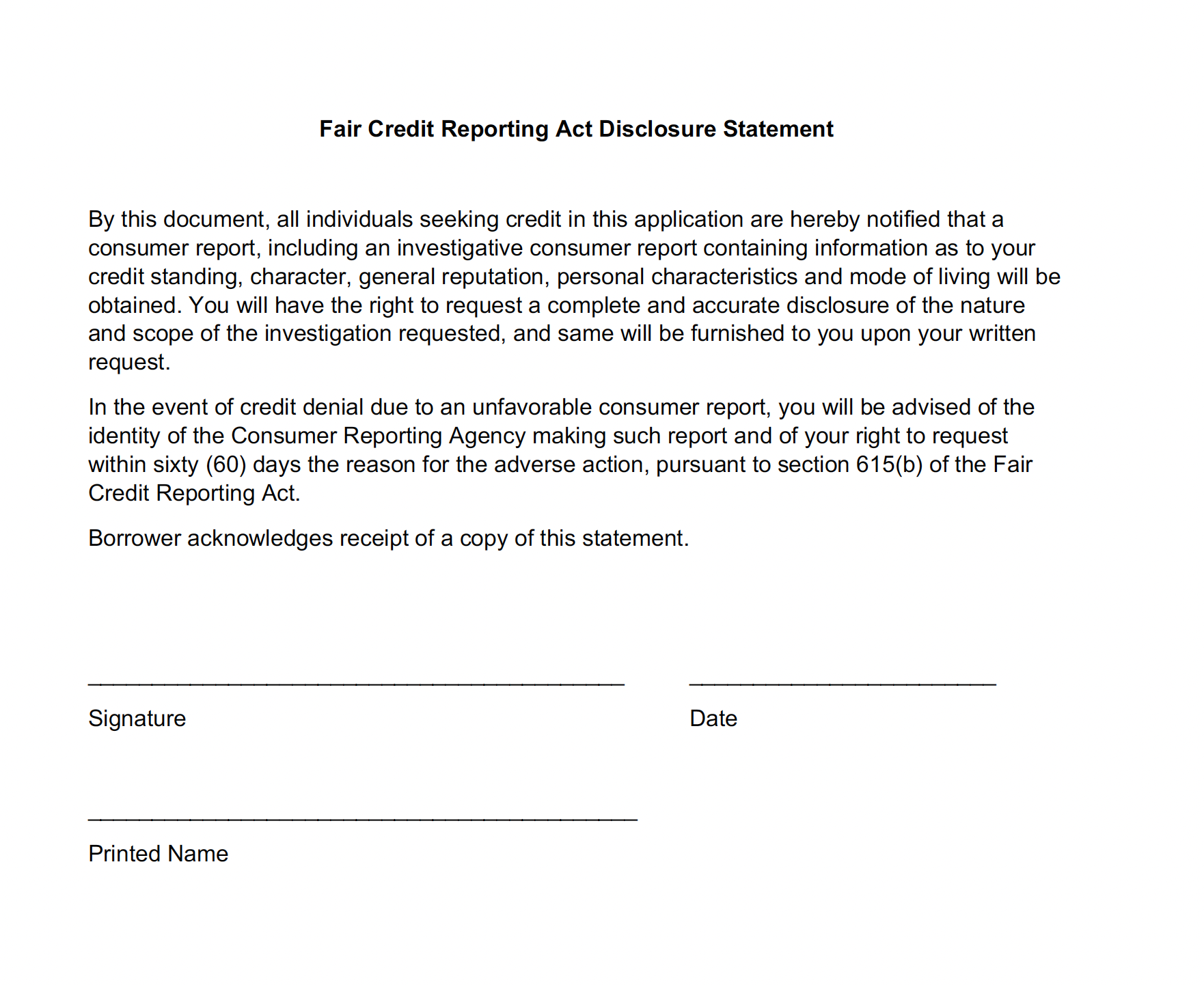
An FCRA (Fair Credit Reporting Act) disclosure is a formal document that employers provide to job applicants or employees, notifying them that the employer intends to obtain a consumer report or background check for employment purposes. This disclosure is a legal requirement under the FCRA, designed to ensure transparency and protect the privacy rights of individuals by informing them that the information obtained through credit reports, criminal history, or other background checks might be used in making employment decisions. It also advises individuals of their rights under the FCRA, including the right to know what is in their file and to dispute inaccurate information.
Free To Use

Lawyer Backed


Fair Credit Reporting Act Disclosure
An FCRA (Fair Credit Reporting Act) disclosure is a formal document that employers provide to job applicants or employees, notifying them that the employer intends to obtain a consumer report or background check for employment purposes. This disclosure is a legal requirement under the FCRA, designed to ensure transparency and protect the privacy rights of individuals by informing them that the information obtained through credit reports, criminal history, or other background checks might be used in making employment decisions. It also advises individuals of their rights under the FCRA, including the right to know what is in their file and to dispute inaccurate information.

A Fair Credit Reporting Act (FCRA) disclosure is the written notice an employer must give a job applicant or employee before obtaining a consumer report about them, such as a background check, credit report or driving record, from a consumer reporting agency. The FCRA, at 15 U.S.C. section 1681b(b)(2), requires the disclosure to be clear and conspicuous, to be made in writing before the report is procured, and to appear in a document that consists solely of the disclosure. The employer must also obtain the person's written authorization, which may be on the same document.
The phrase "a document that consists solely of the disclosure" is where most employers get into trouble. Courts have read it strictly. In Syed v. M-I, LLC (9th Cir. 2017), the court held that including a liability waiver in the disclosure form was a willful violation. In Gilberg v. California Check Cashing Stores, LLC (9th Cir. 2019), the court held that adding state-law disclosures to the same form also violated the standalone rule, and that language a reasonable applicant would not understand failed the clear and conspicuous test. The practical rule: the FCRA disclosure is its own page, in plain language, with nothing else on it except the authorization. State notices, waivers, at-will statements and equal employment language go on separate pages.
If the report will include interviews with neighbors, friends or associates about a person's character or reputation, it is an investigative consumer report and the FCRA, at 15 U.S.C. section 1681d, requires an additional disclosure within three days of requesting the report, along with a statement that the person may request a description of the nature and scope of the investigation.
If the employer intends to take an adverse action based in whole or in part on the report, such as not hiring, not promoting or terminating, the FCRA sets a two-step process. First, before the decision is final, the employer gives the person a pre-adverse action notice with a copy of the report and the Consumer Financial Protection Bureau's form "A Summary of Your Rights Under the Fair Credit Reporting Act," and allows a reasonable time to dispute errors; five business days is the common practice. Second, after the decision, the employer sends an adverse action notice that identifies the consumer reporting agency, states that the agency did not make the decision and cannot explain it, and explains the person's right to a free copy of the report and to dispute its accuracy.
The FCRA creates a private right of action. For a willful violation, 15 U.S.C. section 1681n allows actual damages or statutory damages of $100 to $1,000 per violation, punitive damages and attorneys' fees. Because the disclosure form is used for every applicant, a defective form produces a class of claimants, which is why FCRA disclosure cases are often brought as class actions. Negligent violations carry actual damages and fees under section 1681o.
Several states add their own requirements. California's Investigative Consumer Reporting Agencies Act requires a separate California notice and a checkbox for the applicant to request a copy of the report. New York requires a copy of Article 23-A of the Correction Law when criminal history is considered. A number of cities and states have ban-the-box laws that control when in the hiring process a background check may be run. These notices must be kept off the federal disclosure page.
Because the form must be short and standalone, an FCRA disclosure is one of the easiest employment documents to standardize. Employers and the law firms that advise them typically generate the disclosure, the authorization, and the pre-adverse and adverse action letters from one intake, which Gavel Workflows handles with a single questionnaire. The template on this page is a starting point; have employment counsel confirm it against the states where you hire.
Want us to automatically fill out this template for you? Use this legal app to get guidance and final document you can use in a few minutes. No downloads required.
Gavel Exec is an AI associate that reviews, redlines, and drafts commercial contracts directly in Word. Apply your playbooks in one click


