When you need form FL-141
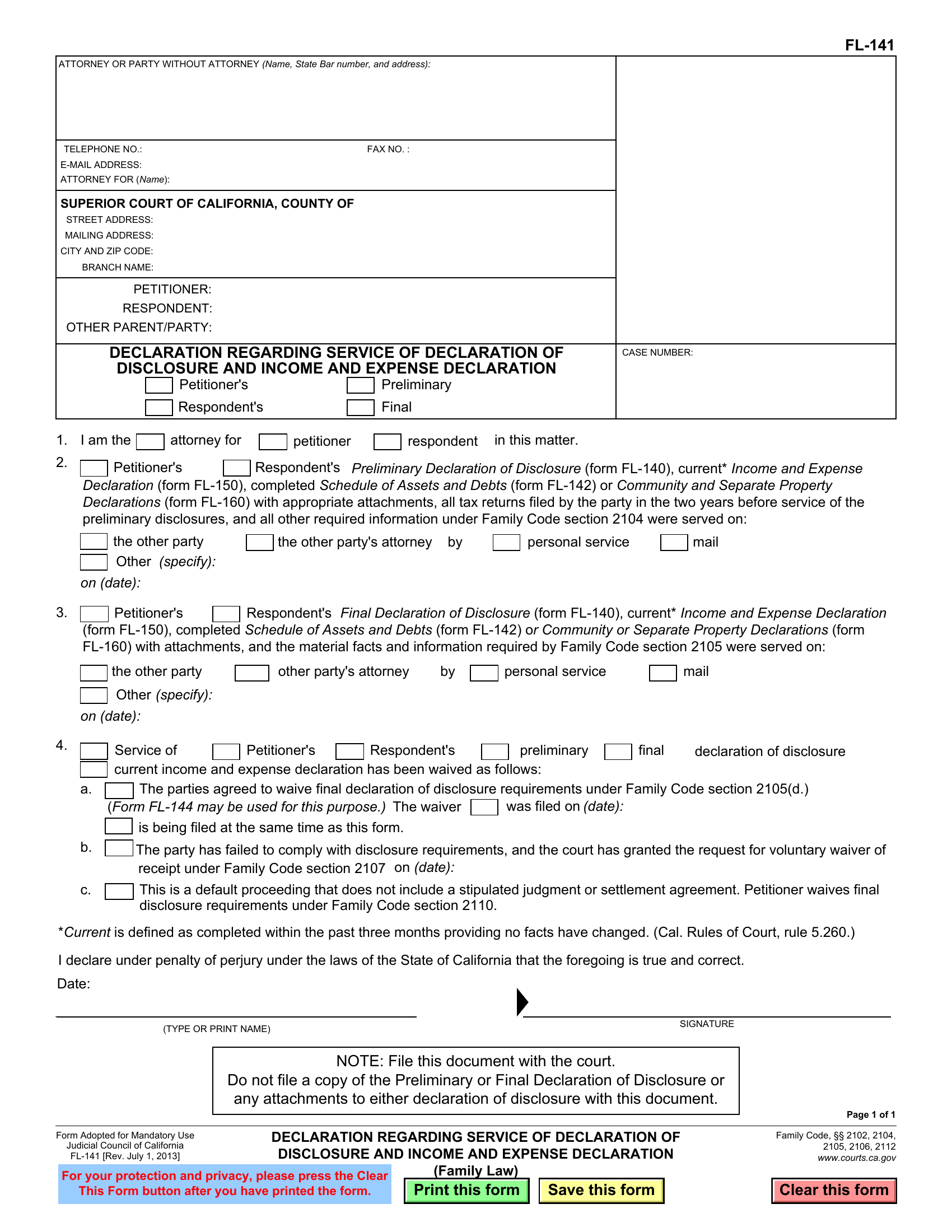
The FL-141 Declaration Regarding Service of Declaration of Disclosure and Income and Expense Declaration is the form that tells a California court you served the required financial disclosures on your spouse or domestic partner. In a divorce or legal separation each party must exchange a preliminary declaration of disclosure, and in most cases a final one, but those disclosures are served on the other party and are not filed with the court. The FL-141 is the one document the court sees, and the judgment cannot be entered until it is on file for both parties (or the other party has defaulted).
The preliminary declaration of disclosure is made up of the Declaration of Disclosure (FL-140) as the cover form, the Schedule of Assets and Debts (FL-142) or the Property Declarations (FL-160), a current Income and Expense Declaration (FL-150), copies of the last two years of tax returns, and a written statement of any investment opportunity since separation that arose during the marriage. Under Family Code section 2104 the petitioner serves it with the Petition or within 60 days of filing the Petition, and the respondent serves it with the Response or within 60 days of filing the Response. The parties can extend these dates by written agreement.
The final declaration of disclosure follows the same pattern and must be served, or waived, before trial or judgment. Parties who have an agreement can waive the final disclosure with a Stipulation and Waiver of Final Declaration of Disclosure (FL-144); the preliminary disclosure cannot be waived. If disclosures are skipped or incomplete, the court can set aside the property division, award an omitted asset to the other party and order attorney's fees and sanctions.
You file an FL-141 each time you complete a disclosure: once for the preliminary declaration and once for the final, or one form that reports both. The related forms in this sequence are FL-100 (Petition), FL-140, FL-142, FL-150, FL-144 and the final judgment forms.
1. Finish the disclosure set first: FL-140, FL-142 (or two FL-160s), a current FL-150 with two months of pay stubs, and copies of your last two years of tax returns. Attach the supporting documents for the assets and debts you list, such as account statements, deeds and vehicle titles.
2. Have someone who is at least 18 and not a party serve the set on the other party or their attorney, by mail or personal delivery. Write down the date and method of service; you will report them on the FL-141.
3. Complete the FL-141. Check whether you are reporting the preliminary or the final declaration, fill in the date served, how it was served and who was served, and confirm that the Income and Expense Declaration and tax returns were included. Sign under penalty of perjury.
4. File the FL-141 with the clerk of the Superior Court where the case is pending, and keep a file-stamped copy. There is no filing fee.
5. Do not file the FL-140, FL-142, FL-150 or tax returns themselves. They stay with the parties. The one exception is a default case, where some courts recommend filing the disclosure forms so the judge can see the assets and debts before entering judgment.
6. If you later serve a final declaration of disclosure, file a second FL-141 for it, or file the FL-144 waiver signed by both parties.