Document Automation
Product features
By practice area
By company size
Contract Review
PRODUCT FEATURES
Resources
LearN
Case Studies
Pricing
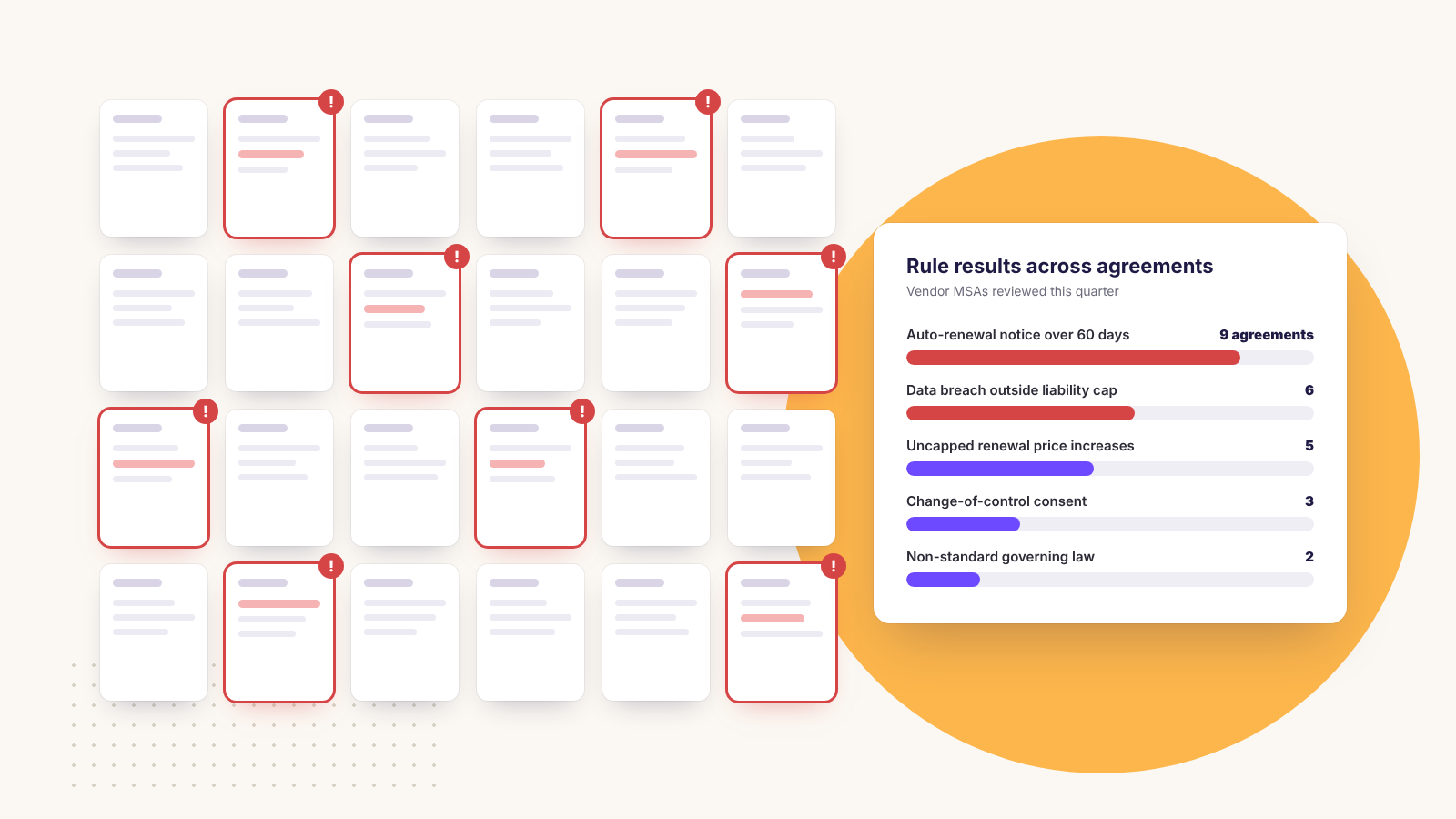
When lawyers review agreements one at a time, risks that repeat across dozens of contracts go unnoticed. Learn where recurring contract risk hides, what a scalable contract review process needs, and how to run a quarterly risk review.
Easy intake and document automation to auto-populate your templates.
Manual contract review is built around the single agreement. A lawyer reads the draft, marks it up, gets it signed, and moves on to the next one. A team can negotiate every agreement reasonably under this process and still build up significant exposure, because the most consequential risks in a contract portfolio are terms that repeat across many agreements.
This article explains what recurring contract risk is, why one-at-a-time review misses it, and what a stronger review process needs in order to catch it. It is written for in-house legal teams that review large numbers of vendor, customer, and partner agreements with a small staff.
Recurring risk is an obligation or exposure that appears in many of a company's agreements and adds up to more than any single contract suggests. Four common examples:
A reviewer reading any one of these agreements in isolation would likely approve it.
A lawyer asks whether an agreement is acceptable for that relationship. A 90-day renewal notice in one software contract is reasonable, and nothing in the review process prompts the lawyer to ask how many other contracts carry the same term.
The output of a manual review is a marked-up document and an email thread. Neither records which issues came up and how they were resolved in a form anyone can search later. Six months on, nobody can say how many vendors received an uncapped data breach indemnity without reading every agreement again.
When three lawyers and a contract manager share the queue, each brings a slightly different threshold for what to flag. The same clause gets marked up in one agreement and accepted in the next, so the company has no consistent baseline to measure its portfolio against.
During diligence, a renewal cycle, or a quarter-end push, reviewers read many agreements in a short period. Definitions, cross-references, and exhibits get less attention late in a long day, and many recurring risks sit in exactly those places.
Order forms, statements of work (SOWs), data processing agreements (DPAs), and amendments often change the terms of the master agreement. A review process that concentrates on the master agreement misses changes made in the documents attached to it.
The table below lists the recurring risks that account for most of the exposure in a typical company's contract portfolio, where each one usually appears, and why it compounds across agreements.
| Risk | Where it usually appears | Why it compounds |
|---|---|---|
| Auto-renewal and notice windows | Term section, order forms | Each missed window commits the company to another term, and deadlines are spread across the year |
| Liability cap carve-outs | Limitation of liability, indemnity, definitions | One incident can trigger uncapped claims under many agreements at the same time |
| One-sided or uncapped indemnities | Indemnification section, statements of work | Exposure accumulates across every counterparty with the same clause |
| Assignment and change-of-control restrictions | General provisions | Each one adds a consent to collect in a financing, reorganization, or sale |
| Data protection terms | DPAs, security exhibits | Subprocessor rights, breach notice periods, and transfer terms vary across vendors, which complicates incident response |
| Termination for convenience | Termination section, order forms | Customer-side rights can make a large share of revenue cancellable on short notice |
| Most-favored-customer pricing and exclusivity | Pricing exhibits, side letters | One commitment can constrain pricing or partnerships across the business |
| Price escalation at renewal | Fees section, order forms | Uncapped increases across many vendors raise costs every renewal cycle |
| Governing law and dispute resolution | General provisions | A mix of forums makes disputes slower and costlier to manage |
A process that catches recurring risk has five properties.
The tracker does not need to be elaborate. A spreadsheet with one row per agreement and these columns is enough to see patterns within a quarter:
The hardest part of a consistent process is running the same rules on every agreement without adding hours to each review. Gavel Exec handles that step for small legal teams:
Gavel Exec works inside Microsoft Word and in the Gavel Exec web app. It is SOC 2 Type II certified, and Gavel has zero data retention agreements with its large language model (LLM) providers.
Manual review evaluates each agreement on its own, records results in redlines and email, and varies by reviewer. Without consistent rules and recorded results, nobody can see how often the same risky term appears across the company's agreements.
Recurring contract risk is a term or obligation that appears across many of an organization's agreements, such as auto-renewals, liability cap carve-outs, or change-of-control restrictions, and creates more total exposure than any single agreement suggests.
Define a playbook for each high-volume contract type, apply it to every agreement, record pass and fail results per rule, and review those results each quarter. AI contract review tools such as Gavel Exec apply the playbook and explain each result, which keeps review time per agreement low.
Yes. Order forms, SOWs, DPAs, and amendments frequently change payment, service level, liability, and data terms in the master agreement, and they should be checked against the same rules.
Quarterly works for most in-house teams. It is frequent enough to catch upcoming renewal deadlines and recurring concessions before they pile up, and infrequent enough to fit alongside day-to-day review work.
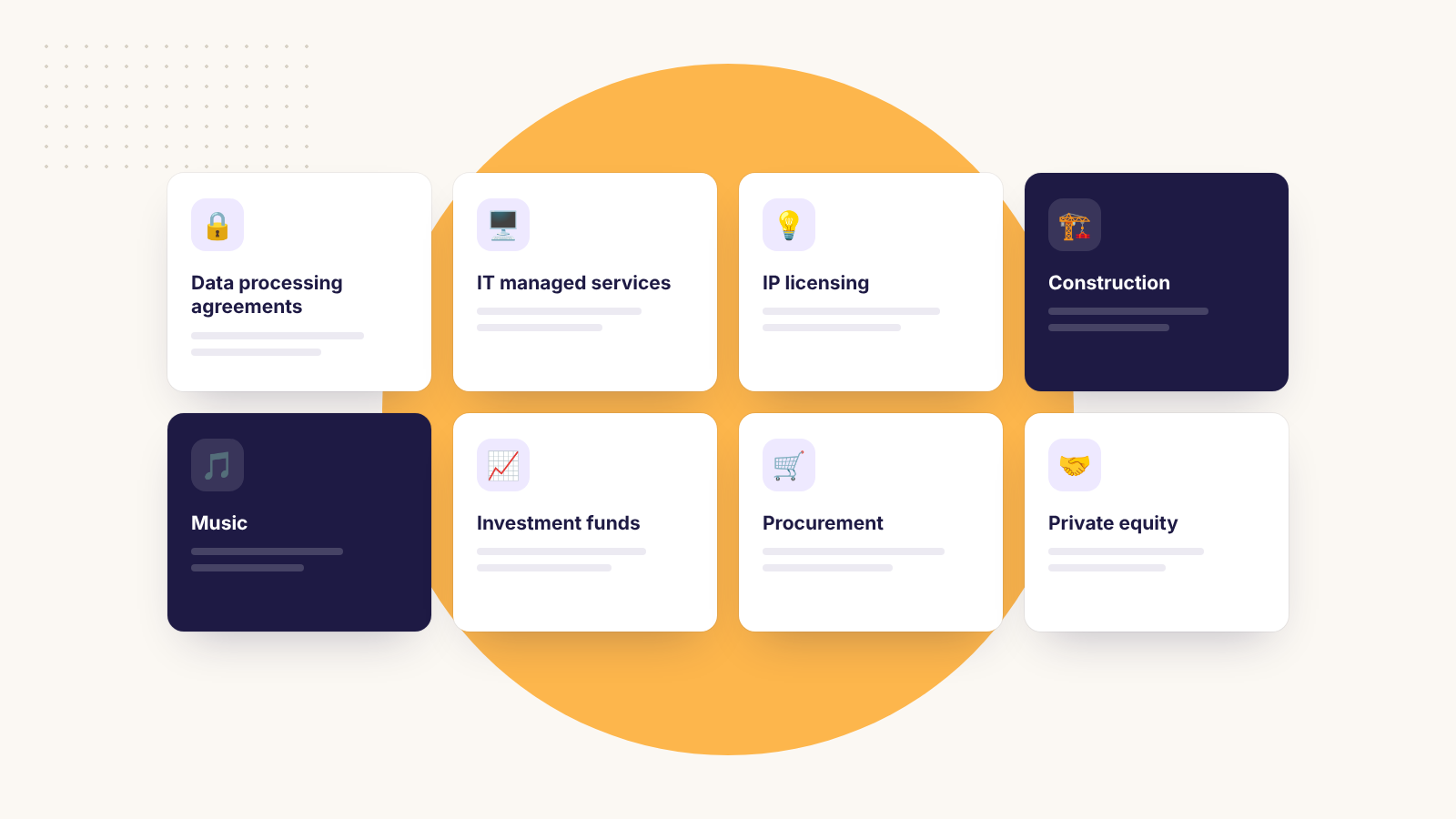
Guides to AI contract review by practice area, covering data privacy, IT managed services, IP licensing, construction, music, investment funds, procurement, and private equity.

How to review LPAs and side letters with AI: the LPA provisions LPs negotiate, how MFN elections work, an MFN tracker you can copy, and the 2026 regulatory context.

How to review music agreements with AI: a worked recoupment example, cross-collateralization, controlled composition at the 2026 mechanical rate, 360 deals, and the seven-year rule.


