Document Automation
Product features
By practice area
By company size
Contract Review
PRODUCT FEATURES
Resources
LearN
Case Studies
Pricing
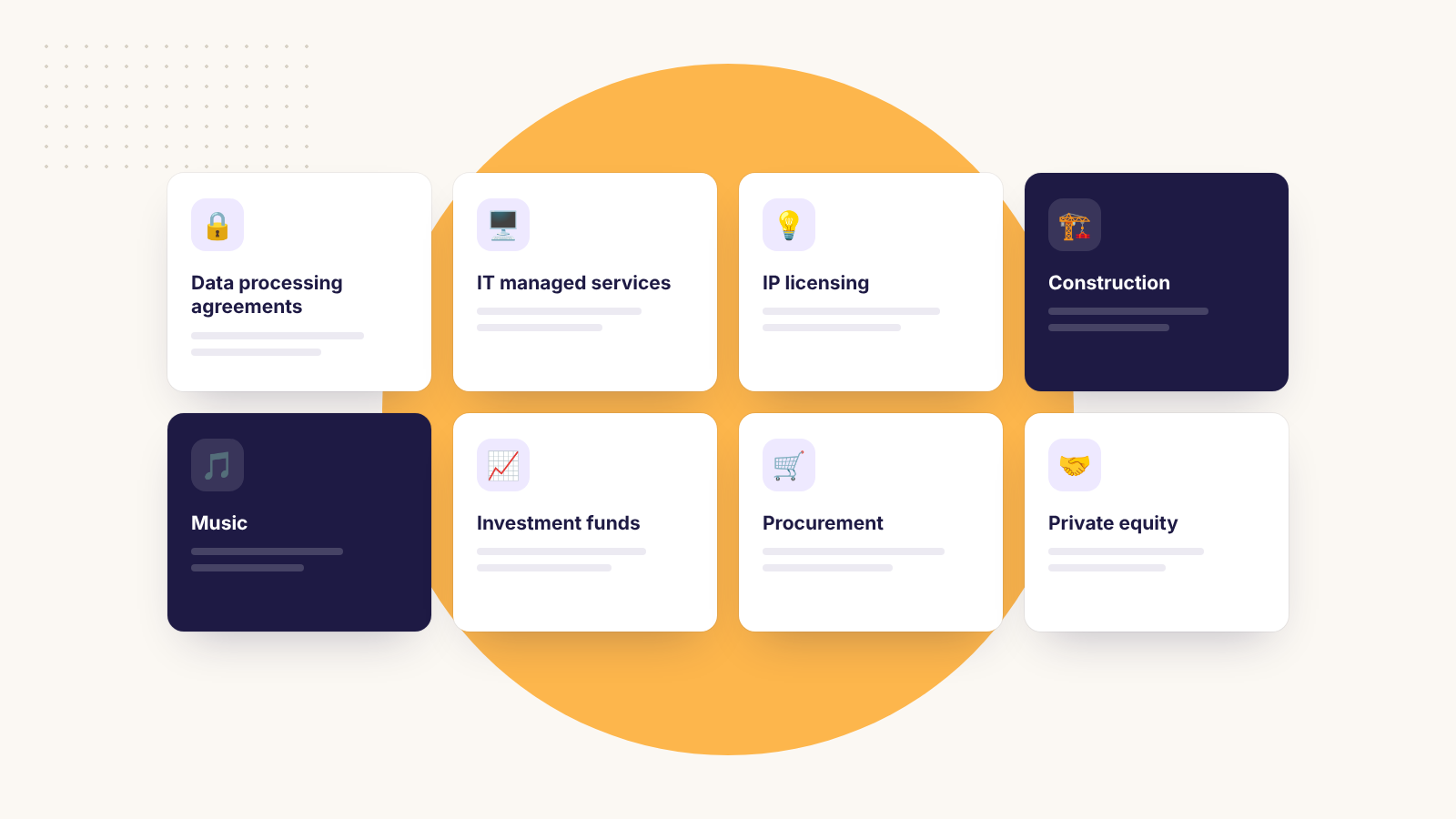
Guides to AI contract review by practice area, covering data privacy, IT managed services, IP licensing, construction, music, investment funds, procurement, and private equity.
Easy intake and document automation to auto-populate your templates.
Every practice area has its own favorite trap. Privacy lawyers watch for sub-processors that appear without notice. Construction lawyers watch for payment clauses that shift the owner's credit risk downhill. Music lawyers watch for the word "recoupable." A good AI contract review tool should know which trap to look for in which contract.
AI contract review works best when the tool applies positions written for the specific contract type. A data processing agreement, a construction subcontract, and a recording agreement each have different clauses, different legal rules, and different red flags. Gavel Exec, an AI contract review add-in for Microsoft Word, lets legal teams run a playbook built for each contract type and returns tracked-change redlines with the reasoning for each change.
This page collects Gavel's guides to AI contract review by practice area. Each guide covers the clauses that matter most, the legal rules that affect them, a practical reference for that area, such as a state-by-state table, a worked royalty example, or an MFN tracker, and how the review works in Gavel Exec.
| Practice area | Agreements covered | Key issues in the guide |
|---|---|---|
| Data privacy | Data processing agreements, CCPA service provider contracts | GDPR Article 28 terms, sub-processors, breach notice timing, international transfers |
| IT managed services | MSAs, statements of work, service level agreements | Order of precedence, uptime and service credits, exit assistance, DORA requirements |
| IP licensing | Software, patent, trademark, and content licenses | Grant scope, field of use, royalties, grant-backs, licensor bankruptcy |
| Construction | AIA and ConsensusDocs forms, subcontracts, riders | Pay-if-paid, anti-indemnity statutes, no-damages-for-delay, retainage |
| Music | Recording, publishing, producer, sync, and 360 agreements | Recoupment, controlled composition, ownership and reversion, the seven-year rule |
| Investment funds | LPAs, side letters, subscription agreements | Waterfalls, key person, GP removal, MFN elections |
| Procurement | Vendor MSAs, SOWs, renewals | Commercial terms, renewals, security addenda |
| Private equity | Purchase agreements, diligence contracts | Change of control, indemnities, diligence across contract sets |
The clauses differ by practice area, but the questions to ask of an AI review tool are the same:
Gavel Exec includes playbooks for common agreements, and teams can generate their own with AI Playbooks by uploading template contracts and negotiation guidelines, then reviewing the rules before use. Playbooks are shared across the team, so every reviewer runs the same positions. For a walkthrough of a full review, see how to review a contract in Microsoft Word with AI. For guidance on moving a team from precedent to playbooks, see why precedent-based review creates bottlenecks.
The best tool is one that lets you apply positions written for each contract type and returns redlines where you negotiate. Gavel Exec runs practice-specific playbooks inside Microsoft Word and links every finding to the clause it relies on.
Yes, if it supports separate playbooks. The same tool can review a DPA, a subcontract, and an LPA, as long as each review uses rules written for that contract type and the side you represent.
No. AI handles the first read, checks each clause against your positions, and drafts standard redlines. Lawyers decide what to concede, apply business context, and handle issues the playbook does not cover.

How to review LPAs and side letters with AI: the LPA provisions LPs negotiate, how MFN elections work, an MFN tracker you can copy, and the 2026 regulatory context.

How to review music agreements with AI: a worked recoupment example, cross-collateralization, controlled composition at the 2026 mechanical rate, 360 deals, and the seven-year rule.

How to review construction contracts with AI: owner, GC, and subcontractor positions on the same clauses, a state snapshot of pay-if-paid rules, anti-indemnity statutes, delay, and retainage.


