Document Automation
Product features
By practice area
By company size
Contract Review
PRODUCT FEATURES
Resources
LearN
Case Studies
Pricing
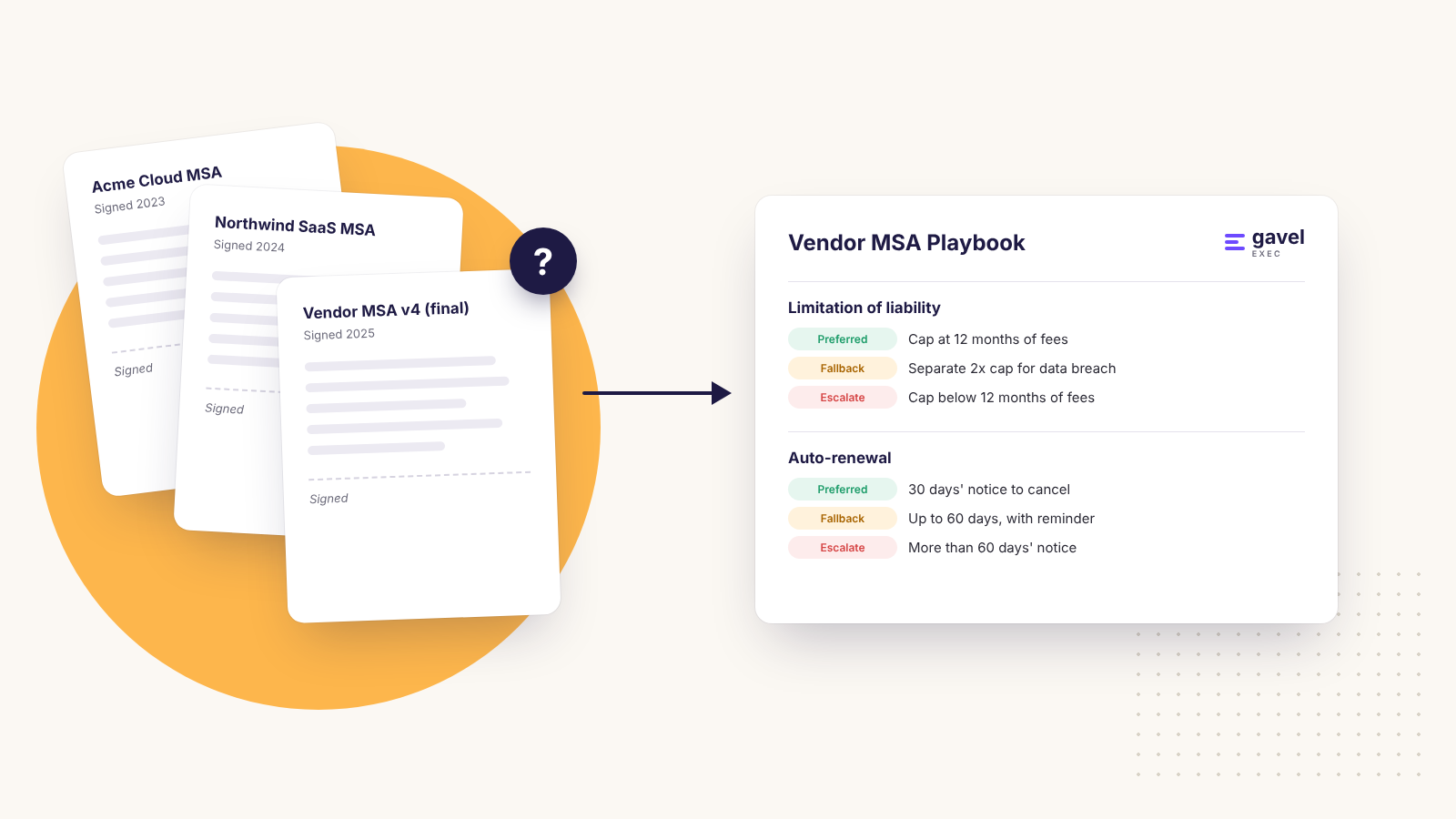
Most in-house teams review contracts by comparing each new draft to a past deal. Here is why that slows small legal teams down as volume grows, what structured, playbook-based review looks like, and how to make the switch in 30 days.
Easy intake and document automation to auto-populate your templates.
Most in-house legal teams review contracts by precedent. When a new vendor agreement arrives, the lawyer finds a similar agreement the company signed before, compares the two, and negotiates toward what the company accepted last time.
For a team handling a few contracts a month, this works well enough. For a team of one to ten lawyers supporting sales, procurement, and partnerships at a growing company, precedent-based review becomes the main reason contracts wait in the legal queue. This article explains where the delays come from, what a structured alternative looks like, and how to move a small team to it without a long implementation project.
A typical precedent-based review has four steps:
Each of these steps depends on an individual lawyer's judgment and memory, and that dependence creates five specific bottlenecks.
Lawyers spend the first part of many reviews looking for a comparable agreement. The best match is often a deal negotiated by a colleague who has since left, saved under a counterparty name nobody remembers. When two precedents conflict, the lawyer has to work out which one reflects current policy before the actual review can begin.
A signed agreement shows what the company accepted. It does not show whether a term was a deliberate position, a concession made to close a large deal at quarter end, or an oversight. A reviewer who treats every signed term as approved will repeat concessions that were meant to be one-time.
When each new deal is negotiated toward the most recent comparable deal, every concession becomes the starting point for the next negotiation. Over a year, the company's effective liability cap, renewal notice periods, and data protection terms can move a long way from what the general counsel would approve if asked directly.
The reasoning behind each position lives with the lawyers who negotiated it. Junior lawyers, contract managers, and business users therefore escalate questions they could otherwise resolve on their own. The general counsel ends up approving routine deviations, and every contract waits for the same few people.
Two lawyers who pick different precedents for the same contract type will negotiate different terms. The company ends up with inconsistent obligations across its vendors and customers, which makes renewals, audits, and acquisition diligence harder.
Most teams do not describe their process as precedent-based. These signs usually indicate that it is:
Structured review starts from a written set of positions for each contract type, usually called a playbook. For each issue the team cares about, the playbook states three things:
The table below shows illustrative rules for a customer-side software-as-a-service (SaaS) vendor MSA. Every company's positions differ, and these examples show the level of specificity that makes a rule usable.
| Issue | Preferred position | Fallback | Escalate when |
|---|---|---|---|
| Limitation of liability | Mutual cap of 12 months of fees; data breach and confidentiality claims uncapped | 12-month cap plus a separate cap of 2 to 3 times annual fees for data breach and confidentiality | Cap is below 12 months of fees, or data breach claims fall under the general cap |
| Auto-renewal | No auto-renewal, or 30 days' notice to cancel | Up to 60 days' notice, with a vendor reminder before the deadline | Notice period exceeds 60 days, or renewal terms are longer than one year |
| Price increases at renewal | Fixed pricing for the initial term; renewal increases capped at 3% | Renewal increases capped at 5% or tied to an inflation index | No cap on renewal increases |
| Changes to terms | Changes only by signed amendment | Vendor may update policies if changes do not materially reduce service or security | Vendor may change any term by posting an update online |
| Data breach notification | Notice within 48 hours of discovery | Notice within 72 hours | No outside time limit, or more than 72 hours |
| Use of customer data | Vendor may use customer data only to provide the service | Vendor may use aggregated, de-identified usage data to improve the service | Any right to use customer content to train AI models |
| Governing law | Company's home state | Delaware or New York | Any other jurisdiction |
With positions written at this level of detail, a reviewer checks the draft against the rules and does not need to locate a past deal or reconstruct why a term was accepted. Concessions made for one deal stay with that deal, because the playbook sets the baseline for the next negotiation. Junior lawyers and contract managers can resolve anything within the fallback range and escalate only the issues that cross a trigger.
Prior agreements still have a role as reference material. A lawyer can consult them when a rule needs interpretation, or when a counterparty claims a term is market standard and the lawyer wants to see what the company signed with similar vendors.
Your signed agreements already contain most of your positions. The work is extracting them:
Writing a playbook used to take weeks of a senior lawyer's time, which is why many small teams never wrote one. AI shortens both the build and the review itself. Gavel Exec supports each part of the process:
After the first two contract types are running well, add the next highest-volume type and repeat the process.
Precedent-based review means evaluating a new contract by comparing it to a similar agreement the organization signed before, and negotiating toward the terms in that earlier agreement.
Reviewers have to find a comparable agreement, reconstruct why its terms were accepted, and escalate questions the precedent does not answer. Those steps depend on a few experienced lawyers, so contracts queue behind them as volume grows.
A contract review playbook is a written list of an organization's positions on each key issue in a contract type. Each rule usually includes a preferred position, an acceptable fallback, and an escalation trigger.
Yes. Gavel Exec generates AI Playbooks from template contracts and internal guidelines that you upload. A lawyer reviews and edits the generated rules before the team uses them.
Start with the one or two contract types that make up most of your review volume. Those playbooks remove the most repeat work, and they give the team a working model before expanding to other types.
No. Structured review applies the positions your team has already decided. Lawyers spend their time on escalations, business context, and terms the playbook does not cover.
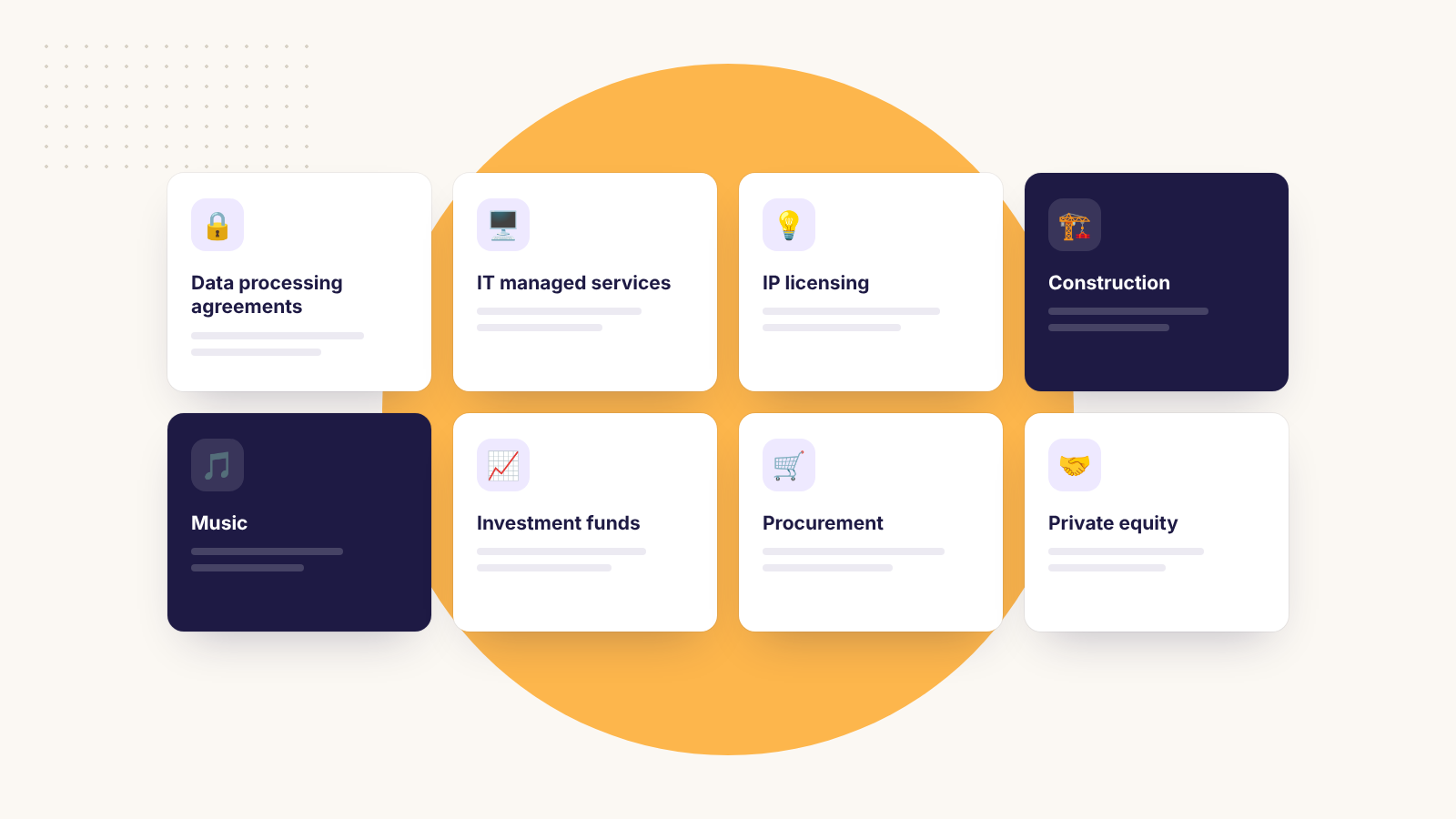
Guides to AI contract review by practice area, covering data privacy, IT managed services, IP licensing, construction, music, investment funds, procurement, and private equity.

How to review LPAs and side letters with AI: the LPA provisions LPs negotiate, how MFN elections work, an MFN tracker you can copy, and the 2026 regulatory context.

How to review music agreements with AI: a worked recoupment example, cross-collateralization, controlled composition at the 2026 mechanical rate, 360 deals, and the seven-year rule.


